


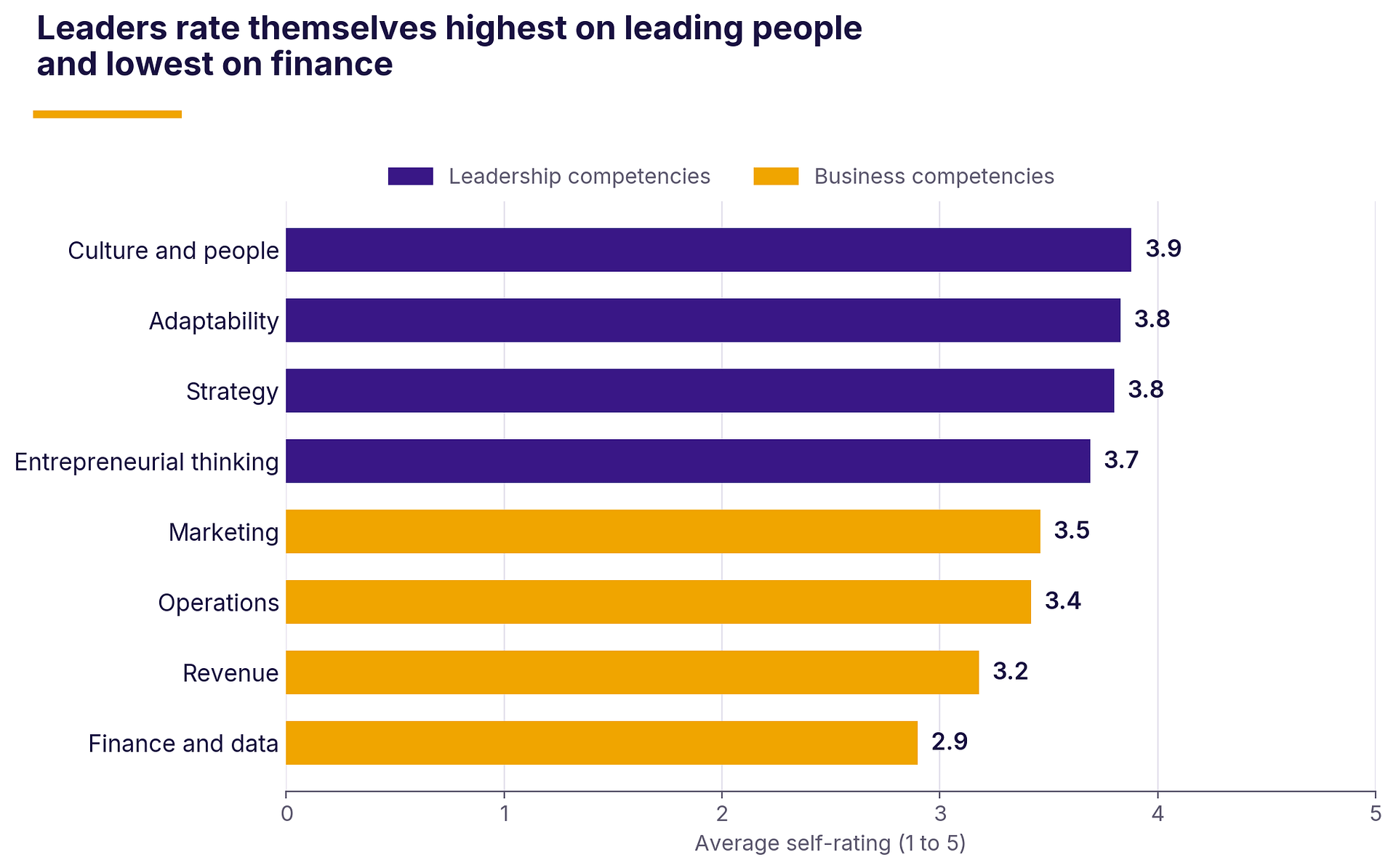
Over the past year, leaders from independent schools across the country and abroad have taken a business competency assessment I make available to anyone who wants it. The tool helps school leaders see where their strengths lie and where they have room to grow across eight competencies: entrepreneurial thinking, strategy, culture and people, adaptability, finance and data, operations, revenue, and marketing.
I recently reviewed the full set of responses to get a clearer picture of where school leaders are right now and where the biggest opportunities are for their professional development. If you lead a school or a senior team, the results offer a useful way to think about where your own growth, and your team’s, might have the greatest payoff.
School Leaders Feel Strongest Leading People Through Change
The highest-rated statements were about adjusting plans as conditions shift, taking the lead on a change, contributing to the strategic plan, and building trust and alignment on a team.
These skills take years to develop, and this group of leaders feels strong in them. That matters, because moving a team is often the hardest part of any decision.
The Biggest Opportunity: Using Numbers to Make Decisions
Finance had the lowest ratings, and the lowest-rated statements shared a common thread. Each involved using evidence to make or test a decision, such as:
- Evaluating a program or position with financial data
- Modeling a scenario before a major choice
- Reading the school’s financial statements
Two contrasts in the results help explain the gap.
First, leaders rated themselves well on spotting new opportunities for the school, but much lower on testing those ideas through research, surveys, or pilots before launching them.
Second, they rated themselves well on refining plans based on data and feedback, while every statement about working directly with financial numbers scored noticeably lower.
One possible explanation is that “data and feedback” can mean very different things. Input from families, faculty, and the board is valuable, but it rarely tells you what a program costs per student or how a staffing change will affect the budget three years from now. Having those numbers in front of your team, alongside what you are hearing from your community, gives everyone a fuller picture before a decision is made.
Business Fluency Can Be Learned, and the Skills Build on Each Other
Strength in people leadership did not carry over to finance on its own. Business fluency does not develop through proximity.
Finance, revenue, and marketing scores did move closely together, though. Leaders comfortable with financial statements tended to be comfortable with the admission funnel and advancement as well. That suggests growth in one area tends to lift the others.
Many of the low scores also reflect a lack of opportunity more than a lack of ability. Most statements in the assessment begin with “I have,” as in “I have modeled a financial scenario.” A leader who has never been asked to do that task will rate themselves low on it. The role of school leadership has expanded quickly, and the chances to practice these skills have not always kept pace. That kind of gap tends to close with practice.
Your Leadership Team May Be at Very Different Starting Points
Leaders were sharply divided on finance. Most rated themselves either quite strong or quite limited, with relatively few in between. The people around your leadership table may be starting from very different places, which is worth keeping in mind as you plan your team’s development this year.

Why Financial Fluency Matters for Leading Change
These leaders already know how to guide a team through change. Financial fluency gives that skill direction.
When a head can show the board or the faculty the cost of a decision and the tradeoffs it requires, the leadership they already practice becomes far more persuasive.
Where to Start
Build a one-page model for a live decision. Pick a decision you’re considering this fall, such as a new program, a position, or a capital request. Before you decide, sit down with your business officer and build a simple model showing the three-year cost, what it could do for revenue or retention, and what you would stop doing to fund it.
Define what “data-informed” means for your team. Ask your leadership team which numbers you are looking at when you call a decision data-informed. My conversation with Cara Gallagher offers a practical way to work through that question by bringing enrollment, retention, financial, and climate indicators into one view your team and board can share.
See where you land. If you’re curious about your own profile, you can take the business competency assessment yourself. Your senior team may also find it a useful starting point for a conversation about growth this year.
Which decision in front of you right now would look different if you could see the numbers behind it?